Posts

anyone found a penny?
Image
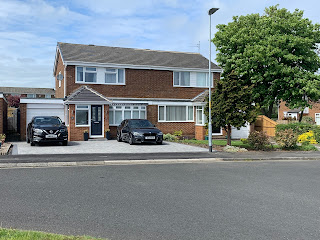
It had to be done. A trip in search of the house in the foundations of which I placed the penny which has given the title to these ruminations. So here it is: The visit of course was a bit of an anti-climax, I was hardly going to ask the current occupants if I could pull up their kitchen floor! But, it was a necessary act of pilgrimage. The house we eventually lived in (several years later!) can just be seen in the background - there is more about that in a previous post. The house with the penny was built in 1973 and as a family we finally moved to Cramlington in 1977 calling it home for four years. Though I have visited the town frequently over the years it was interesting to take this moment to think about the way it has developed and continues to grow. Built round a number of existing communities, even in early 70s it felt like a well established place, with a sense of coherence. Perhaps those who had lived in the old villages felt less sure about the new estates which were filling...

a cornucopia of ordinariness

Image
 Some of the places I am visiting begin unexpected trains of thought. This little selection of brochures, plans and contemporary photos from my Kent and Northumberland trips are nothing more than a record of my collection! Nothing profound, I promise!  It includes a couple of site plans - why not try to match the photos to the exact location on the developments. A challenge I still love ;) Starting in Kent: Good to see a 50 year old house looking so close to how the builders left it! These are on the site plan above Now heading north, to Tintagel Close in Cramlington. My brother was the first owner of this one (c.1976), the builders messed up and had to build the garage down the street. Interesting to see that it is currently being extended.  Now to Morpeth. Lancaster Park was a slightly upmarket development which was developed right through the 70s. It features on the main Leech brochure, providing an interesting historical snapshot. And here's one I knew well, where my ...

a very ordinary house

Image
                                                                            Ordinary things contain the deepest mysteries... This Royal Institute of  British Architects exhibition could not have been better timed for me! Radical Rooms: Power of the plan (architecture.com) 'This exhibition explores the power relations embedded within the layout of our domestic spaces. It uses stories from architectural history and highlights moments when the architectural plan has challenged or changed the conventions of domestic life.' Though the exhibition takes a much longer historical view, the curators start with much the same assumption as I did this sabbatical journey; that the spaces in which we live and how they are laid out shape our perspective on life. It does not focus on the external appearance of ...

The wobbly glass

Image
I love it when a simple item evokes a very special memory. This little whisky glass has done that for me in the last couple of weeks. It was free gift which came with the purchase of a couple of ‘wee drams’ in a Scottish pub a good number of years ago. I was with Gary, a good friend and amazing colleague during an overnight stay in Dunblane. We spent the evening in intense conversation, touching on the deepest issues of family, faith and fragility. We drank enough of the whisky to receive a souvenir glass each! The glasses have a rounded base – so they wobble, no doubt designed to enhance the tasting experience. I have found another significance in the shape. In the first few days of my sabbatical I attended Gary’s funeral. In recent years he had struggled more and more with the complexities of life. In the end he couldn’t find the strength to go on. His passing is a tragedy, but the funeral reminded us all of the profound love and insight which marked him out as a very special perso...

On the edge - 'the Kent Riviera'

Image
Perhaps it's because many of my early experiences were in 'edge' places, the windswept margins that form the North Sea coast of England and Scotland, that I feel an immediate sense of affinity whenever I visit a new place along that margin. It has been described as the Naked Coast*, an apt image for so many places which feel unprotected, exposed to the harshest elements. These places often feel to be far from anywhere, sometimes a bit run down, the people seem to be carrying the battle scars of a long struggle to survive, physical and mental. Given that the landscape is often overlaid with vast holiday parks with their serried rows of white and pale green mobile homes all pointed towards the sea, I can only assume plenty of other people feel this same connection. Who needs long sandy Mediterranean beaches, drenched in sunshine and lined with sparkling white villas?  Just as the wide, freezing, grey waters of the North Sea begin to be funnelled into the even murkier, overcro...

Supermac: Newcastle United meets the Type 27

Image
 Just a few weeks ago Newcastle United languished at the foot of the Premier League table. This weekend after a startling run of form they rose to the giddy heights of mid table. The pattern of the 1971/72 season was much the same, rooted to the bottom of the First Division at the end of October, they finished the season in 11th place, largely thanks to new signing Malcolm Macdonald who scored 30 goals that season. The newcomer from London became a 'Toon' hero, going on to score 138 goals in his 5 seasons with he club. The Leazes End resounded to the chant 'Supermac, Superstar, how many goals have you scored so far?' (think Jesus Christ Superstar to get the tune!) Supermac also became the face of advertising campaigns by Leech Homes, the local builders who have already featured heavily in this blog. The copywriters certainly had some 'super' fun in developing the campaign. This advert from the 'Evening Chronicle', circa 1975 also sets out some of the key...

Drifting back in time

Image
My inspirations for this blog and the forthcoming sabbatical study it introduces, are the housing and many new communities which grew up during the 70s and 80s. This post goes back a little further focusing on a place which was most certainly a 'penny' in the foundations of my life, but which was nearing the end of its existence when I knew it. I write just after tracing my footsteps to that place. If I got my bearings correct, the village was situated on the land to the north (right) of this image. But a lot has happened since I was last there. The 'proper' name was/is East Chevington, but it was always known as Chevington Drift, after the drift coal mine which was the reason for its existence. My visits to this 'pit village' were usually to the Primitive Methodist Chapel, where dad sometimes preached, mum occasionally played the organ and for a short period where I attended Sunday School. I was probably 11 or 12 when I last visited but such was the impression ...